
How to Choose Scarf Fabrics: A Practical Guide
Last Updated: November 2, 2026
Quick Summary
The best scarf fabrics depend on the job the scarf needs to do, its season and setting, and how sensitive your skin is. Natural fibres like silk, cotton and linen breathe well and suit warm weather, while wool and cashmere blends hold warmth for cold months. Check the fibre content and weight, not marketing terms like soft or silky, before you buy.
- Decide the scarf's purpose first: warmth, styling, sun protection or a formal look.
- Natural fibres such as silk, wool, cotton and linen breathe better than most synthetics.
- Warmth depends on knit density and air pockets, not just on the fibre itself.
- Fabric weight in GSM helps compare two scarves of the same fibre.
- Read the fibre percentages and care label; terms like silky or luxe describe look, not composition.
Table of Contents
- Start With the Job the Scarf Needs to Do
- Scarf Fabric Types: Natural Versus Synthetic Fibres
- Warmest Scarf Material and Insulation by Fibre
- Scarf Material Comparison: Breathability, Drape and Weight
- Best Fabric for Scarves by Season, Occasion and Sensitive Skin
- Fibre Blends, Construction and What the Label Tells You
- Scarf Fabric Care Guide: Keeping Your Scarves for Years
- Choose Your Next Scarf at Scarves Australia
- Frequently Asked Questions
Start With the Job the Scarf Needs to Do
Choosing a scarf fabric starts with one question: what do you need the scarf to do? A wrap for a winter commute has different demands from a light square for a summer wedding. At Scarves Australia, we find that most people buy by colour or pattern first and only later realise the fabric is wrong for how they actually wear it. Learn how to tie a shawl with seven elegant techniques so the scarf you choose also stays secure in the setting you have in mind.
Work out the job before you shop. Is the scarf for warmth, styling, sun protection, or a formal look? Each purpose points toward different fibres, weights and weaves. A fabric that drapes beautifully can be useless for keeping you warm on a cold morning.
Be honest about how often you will wear it. A daily scarf needs to be comfortable against the skin and easy to care for; a special-occasion piece can be more delicate.
Write down two or three non-negotiables before you shop, breathability for warm weather, softness for sensitive skin, or a fabric that survives regular washing. Those filters will narrow your options quickly. Once breathability is a non-negotiable, comparing breathable fabric options can help you find a scarf that stays comfortable in warm weather.
Scarf Fabric Types: Natural Versus Synthetic Fibres
Scarf fabrics fall into two broad groups: natural fibres, which come from plants and animals, and synthetic fibres, which are manufactured. Natural fibres such as silk, wool, cotton and linen tend to breathe better and feel more pleasant against the skin. Synthetic fibres are often cheaper, hold their colour well and resist creasing, but they can trap heat and feel less comfortable in warm weather.
Many scarves combine both. A cotton-modal blend, for example, keeps the softness of cotton while gaining the smooth drape of modal, balancing comfort, appearance and durability for everyday wear.
Look at the fibre content on the label or product listing, not just the marketing description. Terms like "silky feel" or "luxe" describe how a fabric looks or feels, not what it is made of. A polyester scarf can be designed to look like silk, and the label is the only reliable way to tell them apart.
Warmest Scarf Material and Insulation by Fibre
Warmth depends on how well a fabric traps still air, not only on the fibre itself. Wool and cashmere are the classic choices for cold weather because their natural crimp creates small air pockets that hold heat close to the body. A densely knitted wool scarf will generally keep you warmer than a loosely woven silk of the same length.
Silk offers surprising warmth for its weight but works best as a layering piece rather than main protection on a freezing day. Cotton and linen are light and cool, better for mild or warm conditions. Synthetic knits can be very warm and practical at a lower price.
If warmth is your priority, check the weight and knit density alongside the fibre. A thick, tightly knit piece in a modest fibre can outperform a fine luxury fabric. For a winter scarf, a medium-weight wool or wool blend is usually the most dependable choice.
Scarf Material Comparison: Breathability, Drape and Weight
Three properties decide how a scarf feels and behaves: how much air passes through it, how it falls on the body, and how heavy it is. Silk and cotton modal blends drape fluidly, which suits a relaxed, flowing look. Our pure silk square in emerald paisley shows this drape in a finished piece. Linen is crisp and airy, though it wrinkles easily, and that texture is part of its appeal.

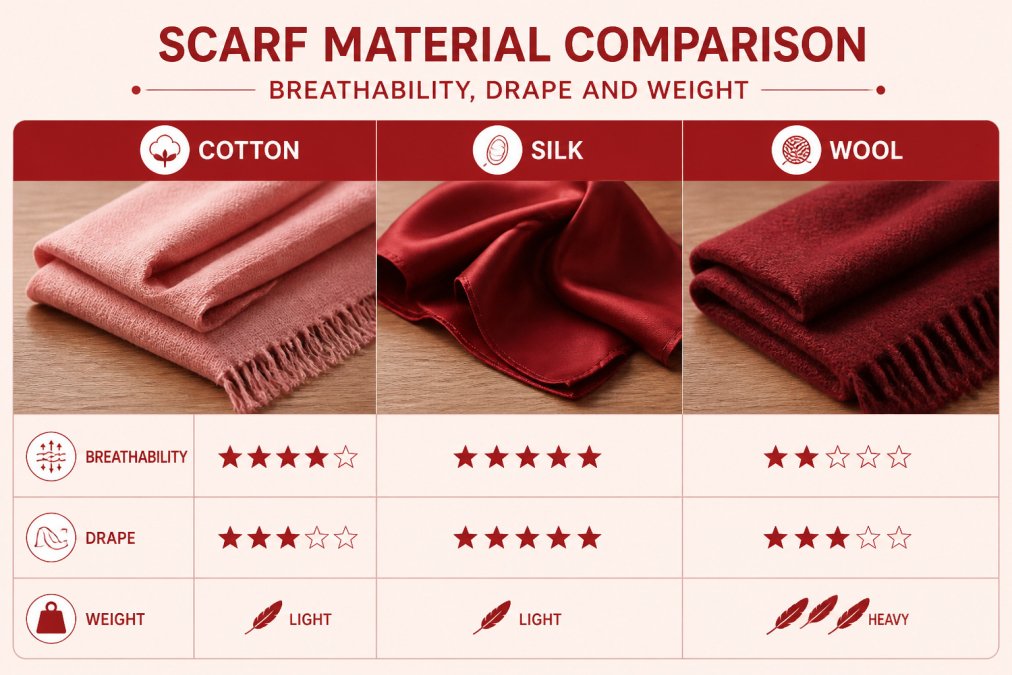
Chiffon is one of the lightest options and almost sheer, ideal for layering over a summer outfit or as a head scarf. Heavier wools and cashmere blends hold their shape for a structured look, while pashmina-style wraps sit between the two.
Weight is the simplest way to compare pieces: lighter fabrics suit spring and summer and pack easily, heavier fabrics suit autumn and winter. Between two scarves of the same fibre, the lighter one will feel cooler and move more freely.
Best Fabric for Scarves by Season, Occasion and Sensitive Skin
The best fabric depends on the season, the setting and your skin. For warm weather, lightweight cotton, cotton-linen blends and chiffon keep you comfortable and look fresh. For cooler months, wool, cashmere blends and medium-weight knits provide warmth. For weddings and formal events, silk and silk-cashmere blends add polish and a graceful drape.
Why some fabrics itch. Irritation around the neck can have several causes, and the fibre's thickness is one of them.
Fibres to favour if you are sensitive. Silk, cotton, linen, modal, lyocell and fine-gauge cashmere are generally the gentlest against the neck. If you want wool, look for fine merino, cashmere or a wool-silk blend, and prefer a smooth, tightly woven or fine-knit construction over a fluffy, brushed one.
How to test a fabric before you buy. For online purchases, check the returns policy before you buy.
Season and occasion, matched to fabric. Warm-weather occasions such as outdoor weddings and summer workdays suit cotton voile, cotton-linen, chiffon and lightweight silk, which breathe and dry quickly. Cooler commutes and evening events suit medium-weight wool, cashmere blends and silk-cashmere, which hold warmth without bulk.
Pure Silk Square Scarf - Emerald Jewel →
Practical filters to apply at the point of sale. Check the fibre content and percentage, the GSM or product weight where published, the construction (woven versus knit, tight versus open), and the care instructions. Match those four against your climate, your skin and how often you will wear the piece.
Watch out: a scarf described as "soft" or "non-itch" in marketing copy is not a fibre claim, ask for the micron count or the exact blend if sensitivity is your main concern, because the label, not the description, is what you can rely on.
Fibre Blends, Construction and What the Label Tells You
A fibre name alone tells you less than the label as a whole. Two scarves both marked 100% wool can behave completely differently depending on how the yarn is spun, how densely the fabric is constructed and how heavy it is.
Blend percentages change performance. The order of fibres on a label runs from highest to lowest percentage, so "70% cotton, 30% modal" is a cotton-dominant fabric with modal added for smoothness, not a modal scarf.
Weight is the most useful number on the label. Fabric weight is usually given in grams per square metre (GSM).
Construction decides how the fabric moves. A woven fabric is made from interlacing warp and weft yarns; it is generally crisper, holds a crease and frays at cut edges unless hemmed.
Yarn and thread count add context. A long-staple yarn (common in better wool and cashmere) has fewer short fibres poking out, so it pills less and feels smoother. Higher thread counts in cotton and silk generally mean a finer, denser fabric, but thread count is not a reliable quality measure on its own.
Read the care symbols as a durability forecast. A scarf labelled hand wash only, cool iron, dry flat is telling you the fibre is sensitive to heat and agitation, expect more careful handling and less suitability for daily wear.
Watch out: a label that lists a trademarked fibre name (a branded modal, lyocell or recycled fibre) without the generic fibre and percentage is not giving you enough to judge warmth, care or durability, ask the seller for the full composition before you commit.
The table below summarises how the main label details affect warmth, care and durability, as covered above.
| Label detail | What it tells you | Practical note |
|---|---|---|
| Fibre percentages | Order runs highest to lowest share | 70% cotton, 30% modal is cotton-dominant |
| Small elastane addition | Improves recovery, reduces pilling | Around 5-15% in a wool blend |
| Lightweight GSM | Roughly 30-80 GSM | Chiffon, fine cotton voile |
| Mid-weight GSM | Roughly 80-200 GSM | Most silk squares, cotton-linen, fine wool |
| Cold-weather GSM | Roughly 200 GSM and up | Wool and cashmere knits |
| Woven construction | Crisper, holds a crease | Frays at cut edges unless hemmed |
| Knit construction | Stretches and traps more air | Can snag or lose shape if hung |
| Care symbols: hand wash, cool iron | Fibre is heat and agitation sensitive | Expect careful handling, less daily-wear suitability |
Scarf Fabric Care Guide: Keeping Your Scarves for Years
Good care is the difference between a scarf that lasts a few seasons and one that lasts for years. Always follow the label first. Many silk and wool pieces are best hand washed in cool water with a gentle detergent, then laid flat to dry away from direct heat. Machine washing on a delicate cycle in a mesh bag works for some cotton and synthetic blends.
Avoid wringing or twisting wet fabric, as this distorts the weave and can stretch knits out of shape; press the water out gently in a towel instead. For wool and cashmere, reduce pilling with a fabric comb or shaver sparingly, and store pieces folded rather than hung.
A common mistake is storing a scarf while it is still slightly damp or dirty, since moisture and body oils can set in stains and odours. Let the scarf dry fully and air it before putting it away, and keep it in a breathable space away from direct sunlight, which can fade bright colours.
Choose Your Next Scarf at Scarves Australia
Once you know the job your scarf needs to do, the fibre that suits your climate and skin, and the care it can handle, choosing becomes much simpler. Our pure silk square scarf in emerald green paisley, at $129.00, suits a range of occasions and anyone who wants a fabric with real drape and lustre. For warm days, our linen-cotton scarf in pastel multicoloured, at $109.00, is a lightweight choice. Our apricot chiffon summer scarf, at $45.00, is a sheer, easy option for layering. For something richer, the luxury shawl in arctic blue, at $199.00, blends silk and cashmere for a soft, elegant wrap.
Browse the lightweight scarf collection to compare fabrics by season, or use the fibre details in each product listing to match a scarf to your own requirements. Start with the job, check the fibre, and the right scarf will be much easier to find.
Frequently Asked Questions
What is the best fabric for a scarf?
There is no single best fabric, because the right choice depends on the job. Silk drapes well and suits everyday and formal wear in mild weather. Wool and cashmere give the most warmth for cold months. Cotton and linen-blend scarves are breathable and suit warm days. Choose by season and purpose first, then by feel and care needs.
Which scarf material is warmest?
Cashmere and fine wool are generally the warmest scarf materials for their weight, because their fibres trap a lot of still air. Pashmina, which is a fine cashmere, performs similarly. Lighter fibres such as silk and chiffon offer little insulation and are better for layering or mild weather. Warmth also depends on how tightly the scarf is knitted or woven.
Are silk scarves suitable for everyday wear?
Yes, provided you are comfortable with more careful handling. Silk is light, smooth and breathable, and it suits everyday outfits in spring, summer and autumn. It is less warm than wool and can mark or snag more easily. A good quality pure silk square, such as the Pure Silk Square Scarf in Emerald Jewel at $129.00, works well for daily styling.
How do I choose a scarf fabric for sensitive skin?
Look for soft, smooth fibres. Silk, fine cashmere and cotton-modal blends are often gentler than coarse wool. If you react to wool, choose a fine cashmere or a cotton-based fabric instead. Test a scarf against the neck for a few minutes before wearing it for long periods, and check the fibre content on the label.