

How to Keep Scarves Looking New: Care Tips That Work
Table of Contents
- How to Wash Silk Scarves at Home Without Damaging Them
- How to Remove Pilling from Wool Scarves (and Prevent It)
- How to Identify High Quality Scarf Fabrics Before You Buy
- Smart Storage: How to Keep Scarves Looking New in Drawers and Wardrobes
- Wrinkle Prevention and Draping for Crease-Free Scarves
- Repair, Travel and Eco-Friendly Care: Angles Most Guides Miss
- Conclusion: Small Habits That Keep Scarves Looking New
- Frequently Asked Questions
Last Updated: September 12, 2026
How to Wash Silk Scarves at Home Without Damaging Them
Learning how to keep scarves looking new starts with one fact: silk is a protein fibre, and protein fibres respond badly to heat, agitation and harsh detergents. Hand-washing at home is straightforward once you know the rules.
Silk is prized for its lustre, drape and temperature-regulating properties, but it loses up to 20% of its strength when wet, which is why gentle handling matters so much.
Hand-Washing Silk: Step by Step
- Fill a basin with cool water (below 30°C) and a few drops of pH-neutral detergent or baby shampoo.
- Submerge the scarf and agitate gently with your fingertips for 2-3 minutes. Never wring or scrub.
- Rinse in cool water until no suds remain. Add a capful of white vinegar to the final rinse to restore shine.
- Press the scarf between two clean towels to remove excess water. Never twist.
Drying and Finishing Silk
Lay the scarf flat on a dry towel, reshape it to its original dimensions, and air dry away from direct sunlight. Once dry, press on the lowest silk setting with a pressing cloth between iron and fabric. According to Heritage Council conservation guidance on textile care, light exposure and heat are among the leading causes of irreversible fibre damage in delicate textiles.
How to Remove Pilling from Wool Scarves (and Prevent It)
Pilling is the formation of small fibre balls on wool, cashmere and other natural fibres, caused by friction and short fibres working loose. It is not a sign of poor quality by itself, but heavy pilling on a new scarf usually signals a shorter staple fibre.
Tools and Techniques for De-Pilling
- Fabric shaver: The fastest option for larger areas. Use light, circular passes.
- Cashmere comb: Best for fine knits and delicate wool. Work in one direction.
- Sweater stone or pumice: Ideal for chunky wool where a shaver risks snagging.
Preventing Future Pilling
Rest scarves between wears, fold rather than hang heavy wool, and wash inside out in cold water. A common mistake is over-washing wool; spot-clean where you can and dry clean only when necessary.
| Pilling Level | Best Tool | Frequency |
|---|---|---|
| Light surface fuzz | Cashmere comb | Monthly |
| Moderate bobbles | Fabric shaver | As needed |
| Heavy, matted pills | Professional dry cleaning | Seasonal |
How to Identify High Quality Scarf Fabrics Before You Buy
Learning how to identify high quality scarf fabrics comes down to three quick in-store tests: touch, drape and stitch. Good natural fibres feel cool and slightly weighty, fall in soft folds rather than stiff creases, and show tight, even hem stitching.
Touch, Drape and Stitch: The Three Tests
Run the fabric between your fingers. Pure silk and fine wool feel smooth and substantial; synthetic blends feel slippery and plasticky. Hold the scarf up and let it fall. Good fabric drapes in fluid curves. Finally, inspect the hem: hand-rolled edges on silk signal craftsmanship, while loose machine stitching suggests corners were cut.
Smart Storage: How to Keep Scarves Looking New in Drawers and Wardrobes
Storage is where most scarf collections quietly deteriorate. The right setup protects fibre integrity, prevents creasing and keeps moths and moisture at bay; the wrong one leaves damage invisible until you unfold a scarf months later and find a crease that will not press out or moth holes along a fold.
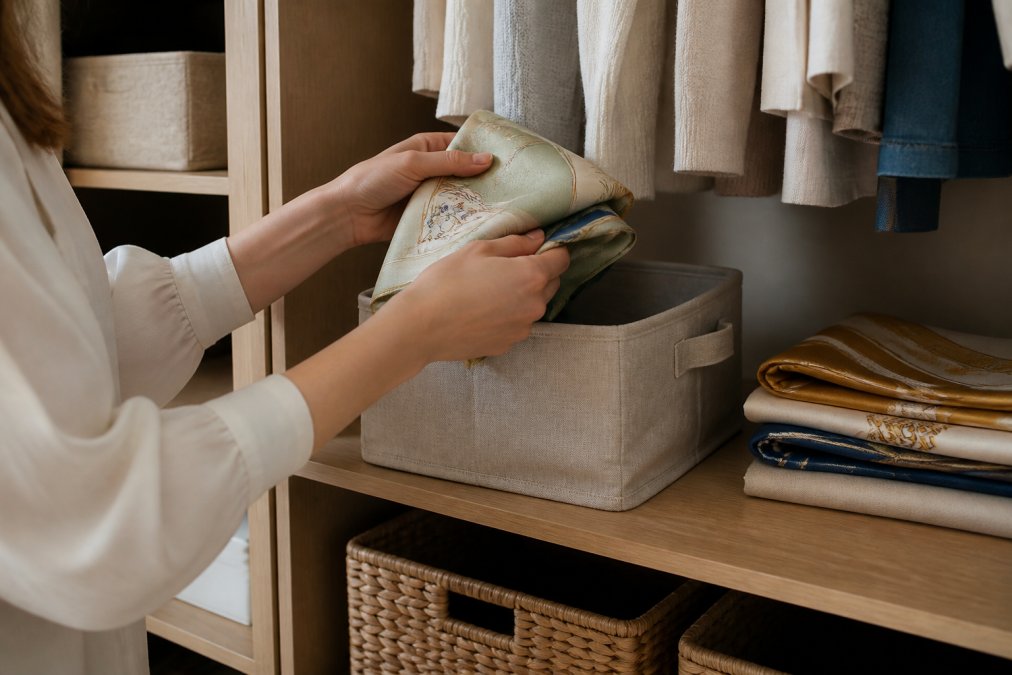
The core principle: natural fibres need to breathe, stay dark, stay dry and stay uncompressed.
Match the Storage Method to the Fibre
Silk, wool, cashmere and cotton behave differently under compression and humidity.
- Silk: Roll rather than fold. Silk is a smooth filament fibre with little natural crimp, so a sharp fold pressed under weight will set a permanent crease line. Roll loosely around an acid-free tissue core and stand the rolls upright in a drawer divider so nothing rests on top of them.
- Wool and cashmere: Fold loosely and store flat, with acid-free tissue layered between folds. Wool has natural crimp and resilience, but it is also the fibre moths target first. Keep these in a breathable bag or a drawer with a pest deterrent, and rotate them so no single piece stays compressed for a full season.
- Cotton and linen: The most forgiving of the group. Folded storage is fine, but cotton and linen crease sharply, so layer tissue between folds and avoid stacking more than three scarves high.
- Blends: Treat a blend according to its most delicate fibre. A silk-wool blend gets silk handling plus moth protection.
Hangers, Drawer Dividers and Acid-Free Tissue
Use non-slip velvet hangers for lightweight scarves you wear often, and drawer dividers to separate folded scarves by fabric type. Hanging organisers suit pashminas and shawls, whose weight helps them hang without slipping. Acid-free tissue prevents yellowing and creasing in long-term storage, ordinary tissue and newsprint are acidic and will slowly discolour natural fibres.
Our Linen Scarf Storage Bag is designed exactly for this: breathable linen that lets air circulate while shielding scarves from dust and light.

What to Avoid: Plastic Bags, Sunlight and Moths
Never store scarves in plastic bags, trapped moisture encourages mildew and yellowing. Keep drawers out of direct sunlight, which fades dyes and weakens fibres; UV exposure is cumulative, so a scarf in a sunlit drawer fades even if never worn.
Moths and silverfish are the single biggest cause of irreversible damage to stored wool and silk. The common clothes moth lays eggs in dark, undisturbed, protein-rich fabric, and the larvae do the eating, not the adults you see flying. That is why infestations are often discovered only when you unfold a scarf and find holes along the fold lines.
Practical pest prevention:
- Clean before storing. Larvae feed on fabric soiled with sweat, skin cells and food residue. A scarf worn once and put away unwashed is a magnet.
- Use cedar blocks or lavender sachets, but refresh or sand cedar every few months, the oils that repel moths fade over time, and a stale cedar block does nothing.
- Check stored pieces seasonally. Shake out and inspect wool and cashmere at the start and end of each cold season. Early detection is the difference between one damaged scarf and a whole drawer.
- Freeze if you suspect infestation. Sealing a suspect scarf in a freezer bag and freezing it for several days can kill eggs and larvae. Let it return to room temperature sealed, so condensation forms on the bag rather than the fabric.
Seasonal Rotation
At the end of each season, wash or dry clean everything before long-term storage, inspect for pests, and store out-of-season pieces flat in breathable bags with tissue between folds. Bring them out, air them and re-fold along different lines next season so creases never set in the same place twice.
Wrinkle Prevention and Draping for Crease-Free Scarves
Wrinkles set when fibres are compressed under weight for long periods. Fold loosely, store flat, and rotate your scarves so nothing stays compressed for months; for silk, roll rather than fold. When draping, hold the scarf at its centre point and let gravity do the work before styling.
Repair, Travel and Eco-Friendly Care: Angles Most Guides Miss
Three areas most care guides skip: travel, repair and sustainability. Each extends a scarf's working life far more than a single wash, and together they separate a scarf that lasts one season from one that lasts ten.
Travel-Specific Care
A scarf is one of the most useful things you can pack and one of the easiest to ruin in transit. The enemies are compression, snagging and hotel laundry.
- Roll, don't fold. Roll each scarf loosely and pack it inside a soft pouch or between layers of clothing. Rolling spreads pressure evenly and avoids the sharp creases that folding under a packed suitcase creates.
- Keep it away from hardware. Zippers, bag clasps and jewellery snag silk and fine wool. A dedicated pouch, or a clean cotton drawstring bag, keeps scarves separated from the rest of your luggage.
- Never leave it in a hotel laundry bag. Those bags are often plastic-lined and trap moisture; a damp scarf left in one overnight can develop mildew.
- Use it, then air it. A silk scarf doubles as a travel pillow cover or a light wrap on cold flights. After wearing, air it overnight before repacking rather than folding it away damp with body heat.
- Spot-clean on the road. A pH-neutral travel detergent and cool water in a hotel basin handles most marks. Press the scarf between towels and lay it flat to dry, never use a hotel hairdryer on silk.
Repair and Restoration
Most damage is fixable if you act before it spreads, and knowing what to attempt yourself versus what to hand to a professional saves money and heartache.
- Pulled threads. Never cut a pulled thread, cutting releases the loop and can unravel a whole row. Instead, use a fine needle or a blunt tapestry needle to ease the loop back through to the wrong side of the fabric, then gently smooth the area.
- Snags on silk. Work the snagged fibre back into the weave with a fine needle from the reverse. If the snag has already broken the yarn, a textile conservator can often re-weave it invisibly.
- Minor stains. Blot, never rub. Rubbing drives the stain into the fibre and can abrade the surface. For oil-based marks, a small amount of pH-neutral detergent and cool water is usually enough; for anything set or unknown, stop and seek advice rather than experimenting.
- Moth holes. Small holes in wool can sometimes be darned invisibly by a skilled mender. Larger or multiple holes, or any damage to a valuable or sentimental piece, are best left to a conservator.
- Dye bleed. This is the one to leave alone. Home remedies for colour run usually make it worse. According to Australian Institute for the Conservation of Cultural Material, professional conservation is always preferable to home repair on valuable or sentimental textiles.
The general rule: if the scarf is inexpensive and the fix is simple, do it yourself. If it is valuable, sentimental, or the damage is structural, get a professional opinion first.
Sustainable Scarf Care
Cold-water hand-washing, air drying and repairing rather than replacing all reduce your wardrobe's environmental footprint. Textile maintenance is one of the most overlooked sustainability habits, the most sustainable garment is the one you already own and keep wearing.
Practical, low-effort changes:
- Wash cold and less often. Wool and cashmere rarely need full washing; airing and spot-cleaning between wears extends the interval significantly.
- Air dry, always. Tumble drying is hard on natural fibres and energy-intensive. Laying flat to dry costs nothing and protects the fibre.
- Choose pH-neutral, biodegradable detergents. They are gentler on silk and wool and break down more readily than conventional detergents.
- Repair before you replace. A re-stitched hem or a re-woven snag keeps a scarf in use for years. The Ellen MacArthur Foundation's work on circular fashion shows that extending a garment's life by even a short period dramatically cuts its carbon impact.
- Store well so you don't rebuy. Good storage is a sustainability measure: it prevents the pest damage and yellowing that send scarves to landfill prematurely.
Conclusion: Small Habits That Keep Scarves Looking New
The difference between a scarf that lasts one season and one that lasts ten comes down to small, consistent habits: cold-water hand-washing, correct storage, and prompt repair. At Scarves Australia, we stock scarves, pashminas and wraps made to be worn and loved for years, and our Linen Scarf Storage Bag makes protecting them effortless. Explore the collection and find your next favourite.
Frequently Asked Questions
What is the smartest way to store scarves to prevent creasing?
Fold scarves loosely and store them flat in a drawer or in a breathable linen bag rather than hanging them for long periods. Use acid-free tissue paper between folds for delicate fabrics like silk and pashmina. Avoid compressing them under heavy items. This simple scarf care habit prevents sharp creases and keeps natural fibres relaxed.
Should you wash your scarves after every wear?
No. Most scarves only need washing every three to five wears, or sooner if they touch your skin directly and absorb oils. Wool and cashmere benefit from airing between wears. Silk should be hand-washed gently when needed. Over-washing breaks down fibres and dulls colour, so less frequent, gentler cleaning is better for longevity.
How can I prevent pilling on my wool and cashmere scarves?
Pilling happens when short fibres rub together and tangle. Reduce friction by storing scarves separately and avoiding rough textures against wool. Wash wool in cold water by hand, never wring, and lay flat to dry. Use a fabric comb or small pill remover when pills appear. Choosing longer-fibre wool and cashmere also reduces pilling over time.
What is the best way to protect silk scarves from moths?
Store clean silk scarves in breathable linen bags or acid-free boxes with cedar blocks or lavender sachets. Moths are attracted to soiled fibres, so wash before storing. Check stored scarves every few months for signs of larvae. Avoid sealed plastic, which traps moisture and encourages mildew. Good ventilation and natural deterrents keep silk safe without harsh chemicals.
Caring for scarves well takes a little effort, but the payoff is a collection that stays beautiful season after season. Scarves Australia offers a boutique range of scarves, pashminas, shawls and wraps for every occasion, with breathable linen storage bags to keep them at their best. Browse the collection and add to cart today.